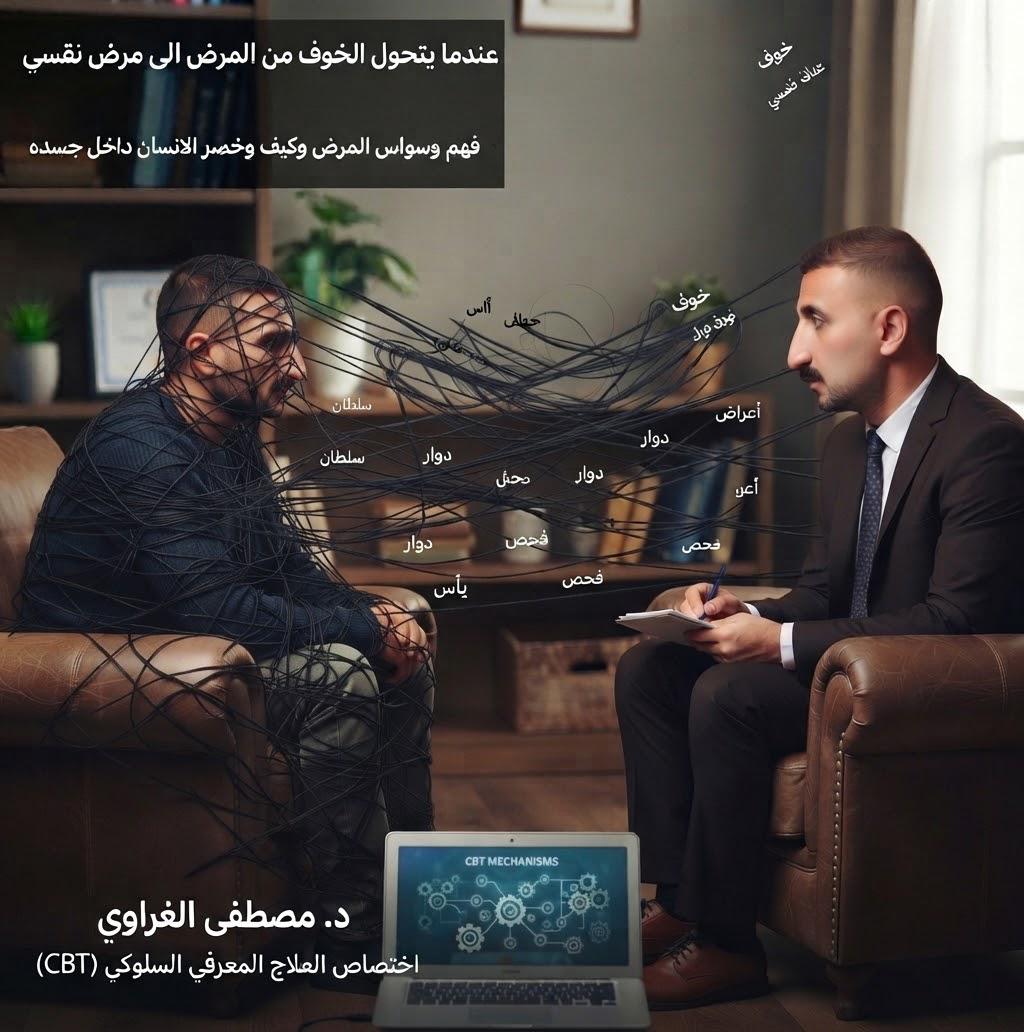
When Fear of Illness Becomes a Psychological Problem Understanding Illness Anxiety and How It Traps a Person Inside Their Own Body Dr. Mustafa Al-Gharawi Cognitive Behavioral Therapy Specialist (CBT)
Fear of illness is a normal human experience. When a person notices an unusual physical symptom, it is natural to pay attention to it and seek an explanation or reassurance. The problem begins when this concern turns into constant monitoring, repetitive thinking, compulsive checking, and endless searching for an explanation that will reassure the mind.
At this point, a person may no longer be afraid only of illness itself, but also of the possibility of having an illness, of failing to detect it, of receiving an incorrect diagnosis, or of something dangerous happening inside the body without being noticed.
This is at the heart of illness anxiety.
What Is Illness Anxiety?
Illness anxiety is a condition in which a person becomes excessively preoccupied with the idea of having, or possibly developing, a serious illness. This fear becomes dominant in their thoughts and behaviors, even when there are no medical findings that match the intensity of the fear they are experiencing.
The obsession may appear in the form of thoughts such as:
"What if this is a serious illness?"
"Maybe the doctors missed something."
"This symptom cannot be normal."
"I need to check myself again just to make sure."
The problem is not simply having thoughts about illness, but the way the person responds to those thoughts and the extent to which they interfere with daily life.
Why Does the Obsession Begin With a Simple Symptom?
The human body is not a silent machine. Everyone experiences different sensations throughout the day: an occasional headache, fatigue, changes in breathing, stomach sounds, muscle tension, numbness, or other minor physical changes.
A person without health anxiety may notice a symptom and eventually shift their attention elsewhere.
A person experiencing illness anxiety, however, may notice the sensation and immediately place it within a catastrophic scenario.
Headache = Maybe it is a serious illness.
Heart palpitations = Maybe there is a heart problem.
Numbness = Maybe it is a neurological disease.
Fatigue = Maybe it is a serious illness that has not yet been discovered.
The fear, therefore, is not necessarily caused by the physical sensation itself, but by the interpretation the mind gives to that sensation.
The Problem Is Not Always the Body, but the Interpretation of the Body
This is one of the most important points to understand.
A physical sensation can be real, while the interpretation of that sensation may not be accurate.
A person may genuinely experience heart palpitations, but that does not automatically mean there is a serious heart condition.
A person may genuinely feel dizzy, but anxiety itself can produce real physical symptoms.
A person may experience muscle tension and then begin monitoring it closely, making them more aware of it and causing it to seem stronger and more disturbing.
An anxious mind does not simply notice a sensation. It immediately tries to explain it, often choosing the most threatening interpretation.
The Cycle of Illness Anxiety
Illness anxiety often follows a repetitive cycle:
A normal physical sensation or temporary symptom
Then a catastrophic interpretation
Then increased anxiety
Then increased monitoring of the body
Then noticing more physical sensations
Then searching, checking, and seeking reassurance
Then temporary relief
Then the doubt returns again.
This is where the problem lies.
The person believes that checking, searching, and reassurance are what protect them from fear. But without realizing it, they may be teaching their brain that anxiety can only be reduced through these behaviors.
As a result, dependence on them becomes stronger.
Why Do You Seek Reassurance and Then Start Doubting Again?
Some of the most common behaviors associated with illness anxiety include:
Asking the doctor repeatedly.
Repeating medical tests without a clear medical reason.
Comparing symptoms with those of other people.
Searching the internet.
Frequently asking family members for reassurance.
Monitoring the heartbeat.
Examining the body in the mirror.
Pressing a particular area to check whether something is wrong.
Constantly paying attention to every physical change.
The person may experience genuine relief afterward.
But the relief is temporary.
Hours or days later, a new thought may appear:
"But what if there was something the test did not detect?"
And the cycle begins again.
That is why constant reassurance may reduce anxiety for a moment, but it does not address the underlying cycle when reassurance becomes a repetitive compulsive behavior.
Why Is the Obsessive Mind So Difficult to Satisfy?
Because the obsessive mind is not looking for information alone.
It is looking for complete certainty.
This is a crucial point.
A person may say:
"I want to be one hundred percent sure that I will never become ill."
But no human being can obtain complete certainty about the future.
Life naturally contains uncertainty.
Therefore, the therapeutic goal is not to achieve absolute certainty, but to develop the ability to tolerate a reasonable degree of uncertainty without engaging in compulsive behaviors.
The Obsessive Mind Loves the Words "What If?"
"What if the illness is really there?"
"What if the doctor made a mistake?"
"What if a dangerous sign appears and I do not notice it?"
"What if this symptom is different from the previous ones?"
"What if the test was not enough?"
Each of these questions may sound reasonable on its own.
But when the mind becomes accustomed to generating dozens of such possibilities every day, the problem is no longer the question itself. The problem is the inability to leave the question unanswered.
Every answer creates another question.
And so the person ends up living inside an endless mental courtroom.
Illness Anxiety Does Not Survive on Thoughts Alone, but on Behaviors
One common mistake is trying to get rid of the thought itself.
A person may say:
"I must stop thinking about illness."
But trying to force the thought away can make the person even more focused on it.
The more important therapeutic focus is what happens after the thought appears.
When the thought of illness arises:
Do I search for hours?
Do I check my body?
Do I ask someone else for reassurance?
Do I repeat a medical test unnecessarily?
Do I monitor my heartbeat?
Do I open the internet?
Do I repeatedly seek reassurance?
This is where meaningful change begins.
Cognitive Distortions in Illness Anxiety
Illness anxiety is often fueled by several thinking errors, including:
Catastrophic Thinking
The mind moves from a minor possibility to the worst possible scenario.
Magnifying Physical Sensations
Treating a small symptom as strong evidence of a serious problem.
Selective Interpretation
Focusing on one frightening piece of information while ignoring the rest of the reassuring evidence.
Intolerance of Uncertainty
Believing that a person must know exactly what is happening and what will happen.
The Need for Complete Certainty
Being unable to accept uncertainty and constantly needing a final answer that leaves no room for doubt.
Confusing Possibility With Reality
The fact that something is possible does not mean that it is actually happening.
The thought:
"It could be an illness"
is completely different from:
"I have this illness."
Why Do Symptoms Feel Stronger When You Monitor Yourself?
When a person directs their attention continuously toward their body, they begin noticing details they previously ignored.
The heartbeat becomes more noticeable.
Breathing becomes something to monitor.
The stomach becomes something to check.
Muscle movements become more noticeable.
This constant focus can increase awareness of physical sensations and make them seem more significant and disturbing.
Then the obsession says:
"See? There really is something wrong."
The person monitors even more, anxiety increases, and the physical sensations increase as well.
Thus, the person becomes trapped in a closed loop.
Anxiety Can Produce Real Physical Symptoms
This point is extremely important to understand.
Physical symptoms caused by anxiety are not imaginary symptoms.
Fear and anxiety can be accompanied by heart palpitations, muscle tension, sweating, dizziness, stomach problems, rapid breathing, and other physical sensations.
This can lead to a common mistake:
"I am afraid, and my body is giving me symptoms, so I must be ill."
When, in fact, some of these symptoms may be part of the body's anxiety response itself.
This does not mean that genuine medical symptoms should be ignored. It means that not every physical sensation should automatically be interpreted as evidence of a catastrophe.
There Is a Difference Between Caring for Your Health and Obsessing About It
Taking care of your health is a healthy behavior.
But there is a major difference between:
"I have a persistent symptom and I want to have it medically evaluated."
and:
"I feel something minor, so I need to check myself ten times, search the internet, ask everyone, and then check again."
The difference is not simply whether concern exists, but in its nature, frequency, and impact on life.
Healthy health-related behavior is organized and proportionate to the situation.
Obsessive behavior is driven by fear and requires repetition in order to obtain temporary relief.
Sometimes a Person Becomes a Prisoner Inside Their Own Body
This is where the most painful aspect of the problem becomes visible.
A person may gradually lose the ability to enjoy life.
Waking up in the morning becomes connected to monitoring the body.
Food becomes connected to fear of how it might affect the illness.
Going out becomes connected to fear that a symptom might occur.
Sleep becomes another opportunity to monitor the heartbeat and breathing.
Eventually, a person may feel that their body is no longer a place to live, but a place to inspect.
At this point, the goal of treatment is not only to reduce fear of illness, but to reclaim life from constant monitoring.
The Role of Cognitive Behavioral Therapy
Cognitive Behavioral Therapy, or CBT, is one of the approaches used to address obsessive thoughts and health-related fears. It focuses on understanding the relationship between thoughts, emotions, and behaviors.
In illness anxiety, treatment is not based on convincing the person every time that they are healthy. Instead, it helps the person change their response to fearful thoughts and uncertainty.
Important skills may include:
Identifying the obsessive thought.
Distinguishing possibility from fact.
Recognizing catastrophic thinking.
Reducing repeated reassurance seeking.
Reducing compulsive body checking.
Stopping excessive illness-related internet searches.
Learning to tolerate uncertainty.
Returning to normal activities despite anxiety.
Not allowing fear to determine daily decisions.
What Should You Do When the Thought of Illness Appears?
Do not enter into a long debate with the thought.
You do not need to prove the opposite ten times.
You can respond in this way:
"This is an obsessive thought."
"Having the thought does not mean that I have the illness."
"I will not achieve complete certainty."
"I can allow the anxiety to be present without feeding it through compulsive behavior."
Then return to what you were doing.
You may feel anxious.
You may feel uncomfortable.
The doubt may remain for some time.
That is normal.
Recovery does not mean that you will never feel afraid. It means that fear will no longer be able to control your life.
Do Not Turn Analysis Into a Way of Life
Some people spend hours thinking:
Why did I feel this?
When did it start?
What does it mean?
Has this happened to me before?
Does someone in my family have something similar?
Have I read about this symptom?
Could it be something rare?
Could the doctor be wrong?
This is not always an attempt to understand.
It may be part of the obsessive ritual.
So ask yourself:
"Am I actually solving the problem, or am I simply thinking about it again and again?"
The Goal Is Not to Love Uncertainty, but to Tolerate Its Existence
You do not need to become convinced that everything will be perfect.
Nor do you need to tell yourself:
"I am completely certain that I will never become ill."
A more realistic statement may be:
"I may not know everything, but I can continue living my life without checking every possibility."
This is where psychological freedom begins.
When Is Medical Evaluation Important?
Having illness anxiety does not mean ignoring genuine medical symptoms.
When there is a new, severe, persistent, worsening symptom, or a symptom that raises legitimate medical concern, appropriate medical evaluation is important.
However, after receiving an appropriate medical assessment, it is important to avoid allowing follow-up to become a repetitive compulsive ritual without medical necessity.
In other words:
Do not neglect the body, but do not let fear control the body.
The Most Important Message for Someone With Illness Anxiety
You are not weak.
You are not crazy.
You are not necessarily suffering from every illness your mind tells you about.
You are a person whose mind has learned to associate physical sensations with danger, uncertainty with the need to check, and fear with the need for reassurance.
And this pattern can be changed.
Your problem today may be that you monitor your body more than you live your life.
But recovery begins when you move from:
"How can I make sure that I will never become ill?"
to:
"How can I live my life while accepting a normal degree of uncertainty?"
When you stop turning every sensation into a case, every thought into an alarm, and every doubt into a reason to check, the mind begins to learn a new way of responding.
You do not need to win every battle with the obsession.
You simply need to stop feeding it.
Your body is not your enemy. Fear does not always tell the truth, and a thought is not a fact simply because it feels frightening.
Life does not begin when you achieve complete certainty.
Life begins when you stop waiting for complete certainty before allowing yourself to live.