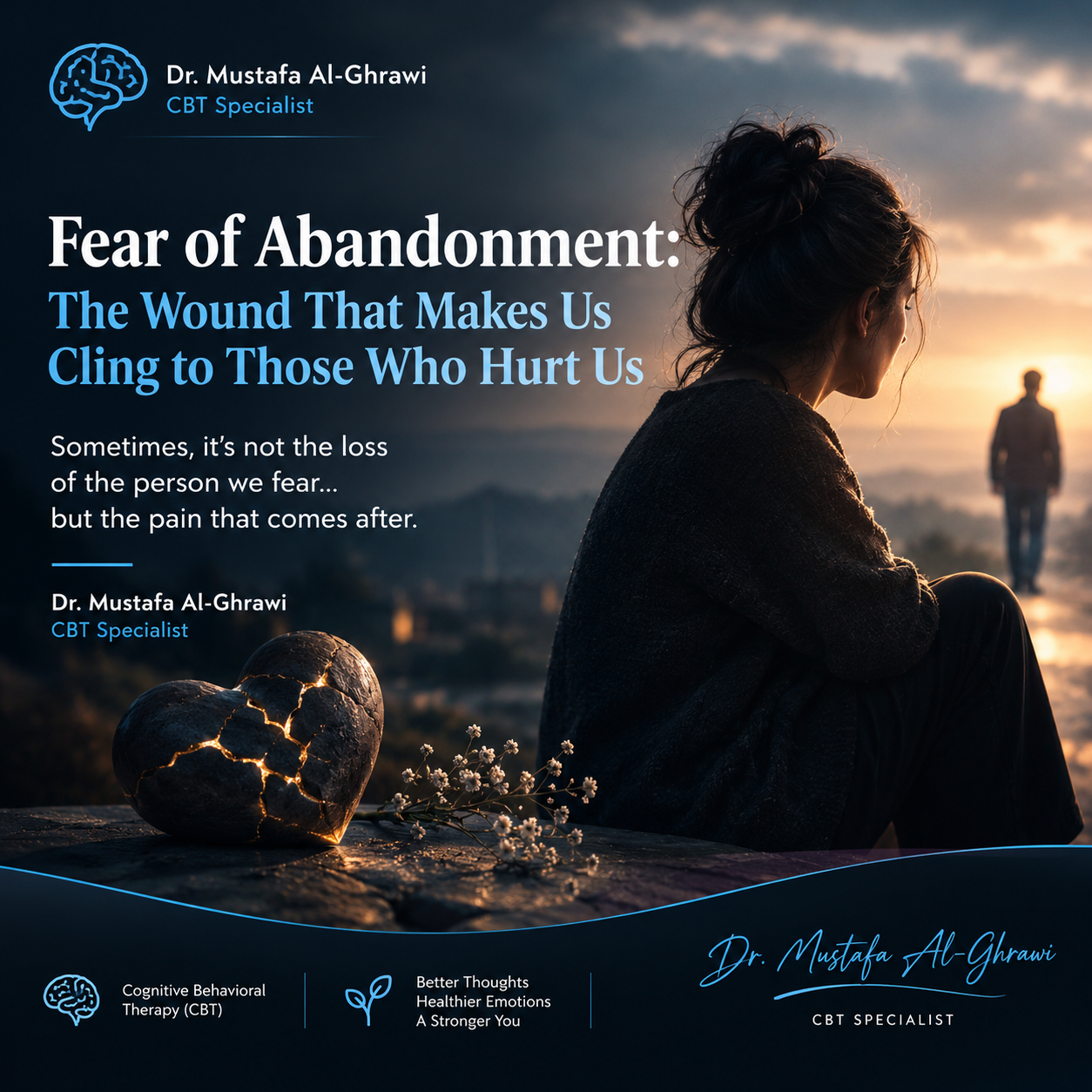
Fear of Abandonment: The Wound That Makes Us Cling to Those Who Hurt Us Dr. Mustafa Al-Ghrawi CBT Specialist
In some relationships, our real fear is not necessarily losing the person, but the feelings that come after losing them.
We fear loneliness, emptiness, the thought that no one will love us again, and the question that keeps haunting us:
"What if they really leave me?"
Because of this fear, a person may hold on to a relationship that hurts them. They may give up their rights, tolerate coldness, neglect, or hurtful behavior, and constantly justify the other person's actions simply to avoid experiencing abandonment.
This is where the difference between love and attachment begins.
Love gives a person the space to be themselves. Attachment driven by fear of abandonment, however, can make a person feel that their existence and emotional security depend on another person.
Where Does the Fear of Abandonment Come From?
Fear of abandonment can be connected to experiences a person had during childhood or in previous relationships.
They may have experienced loss, neglect, separation, emotional instability, or a repeated feeling that someone they depended on could leave at any moment.
Over time, a painful belief may develop:
"If I do not hold on to people, they will leave me."
Relationships then become more than a place for love. They become a place where the person tries to protect themselves from fear.
How Does Fear of Abandonment Appear in Relationships?
It may appear as constant monitoring.
Why did they take so long to reply?
Why has their way of speaking changed?
Why are they talking less?
Is there someone else?
Do they still love me?
Are they thinking about ending the relationship?
This anxiety may lead to repeated behaviors such as sending excessive messages, calling constantly, analyzing every word, monitoring social media activity, looking for signs of change, or repeatedly testing the other person's feelings.
In some cases, a person may give up important parts of themselves simply to prevent the relationship from ending.
They may say:
"The most important thing is that they do not leave me."
At that point, fear becomes stronger than self-respect.
Why Do We Cling to People Who Hurt Us?
Because when a person is afraid, the mind does not always look for a healthy relationship. It looks for relief from the perceived threat.
When someone feels that the other person may leave, even a simple message or small amount of attention can provide temporary relief.
The anxiety disappears when the person reconnects.
Then the anxiety returns when they pull away.
The person can become trapped in a repeating cycle:
Fear
Then monitoring
Then reaching out
Then temporary reassurance
Then distance
Then fear again.
As this cycle continues, the attachment may become stronger, even when the relationship itself is causing pain.
The Problem Is Not Always the Other Person
In some cases, the other person may genuinely be hurtful, unclear, manipulative, or unwilling to commit.
But there is another question that also needs to be understood:
Why did I stay despite the pain?
Why am I afraid of losing someone who does not make me feel emotionally safe?
Why am I giving up parts of myself just to keep the relationship?
These questions are not meant to blame the person. They are meant to help them understand themselves.
Because overcoming unhealthy attachment does not always begin with trying to forget the person. Sometimes it begins with understanding why that person became so psychologically important.
Fear of Abandonment Can Change the Way We Interpret Hurt
When a person is afraid of losing someone, they may start justifying the other person's behavior.
"They are tired."
"Maybe they are going through difficult circumstances."
"They love me, but they do not know how to express it."
"Maybe I am being too sensitive."
"They will change with time."
Some of these explanations may be true, and some may not be.
The problem begins when justification becomes a constant way of avoiding the reality of the relationship.
Not every period of distance means abandonment.
Not every disagreement means the relationship is ending.
At the same time, not every hurtful behavior can be justified in the name of love.
How Can We Begin Dealing With Fear of Abandonment?
First: Identify the Thought Behind the Fear
When someone distances themselves from you, ask yourself:
What exactly am I afraid of?
Am I afraid of losing this person?
Or am I afraid of being alone?
Am I afraid that no one else will love me?
Am I afraid that I am not enough?
Am I afraid of repeating an old experience?
Understanding the real fear helps you deal with it instead of running away from it.
Second: Do Not Let Anxiety Control Your Behavior
When you feel afraid, do not immediately react.
Do not send dozens of messages.
Do not spend hours monitoring the other person.
Do not threaten to end the relationship and then immediately take it back.
Do not abandon your boundaries just to receive temporary attention.
Give yourself time to calm down, and then decide what you actually want.
Third: Separate Love From Need
You can love someone without making their presence a condition for feeling worthy.
A healthy relationship should add to your life, not replace your life.
You need your own life, work, friends, interests, goals, and sense of self.
The wider and more meaningful your life becomes, the less likely one person will become the center of your entire world.
Fourth: Pay Attention to Your Boundaries
Ask yourself:
What are the things I will not accept in a relationship?
Are my feelings respected?
Can I express my needs without fear?
Do I feel emotionally safe, or am I constantly living in a state of anticipation and anxiety?
Am I in a mutual relationship, or am I giving everything just to prevent the other person from leaving?
These questions may reveal things you have been avoiding.
Fifth: Learn to Tolerate Distance
One of the hardest steps for an attached person is learning that distance does not necessarily mean the end of a relationship.
You do not always have to do something when fear appears.
Sometimes you simply need to allow the feeling to exist until it passes.
Anxiety rises, and then it falls.
Every time you learn that you can tolerate the feeling without chasing the other person, your ability to regulate yourself becomes stronger.
Do Not Let Your Fear of Abandonment Make You Abandon Yourself
Perhaps one of the most painful things about some relationships is that a person does not only lose the other person. They lose themselves as well.
They stop living their own life.
They distance themselves from friends.
They neglect their work.
They lose interest in themselves.
Their entire day becomes connected to a message, a phone call, or a reaction from someone else.
At this point, we need to stop and ask:
"Am I trying to preserve this relationship, or am I trying to escape my fear?"
The difference between the two is significant.
The person you are afraid of losing may be important in your life, but you are also important in your own life.
No relationship should require you to lose yourself as the price of keeping it.
From a Cognitive Behavioral Therapy Perspective
Cognitive Behavioral Therapy helps us understand the relationship between thoughts, emotions, and behaviors.
For example, the thought:
"If they leave me, I will fall apart"
may create anxiety.
That anxiety may lead to monitoring, excessive contact, and attachment.
Then the other person's response may reinforce the original thought.
This is why therapy can focus on examining these thoughts, distinguishing fear from facts, learning more balanced responses, and developing a greater ability to tolerate emotions without turning them into behaviors that harm the person.
The goal is not to become emotionless.
The goal is to feel your emotions without losing control of yourself.
Remember
A person who fears abandonment sometimes needs to learn something greater than how to keep people from leaving.
They need to learn how to feel safe within themselves.
Because true emotional security does not always come from knowing that everyone will stay.
It also comes from knowing that you can continue even when someone leaves.
That you can grieve without falling apart.
That you can love without erasing yourself.
That you can reject hurt without feeling guilty.
And that losing a relationship does not mean losing your worth.
Someone may leave your life, but do not allow your fear of losing them to make you leave yourself.