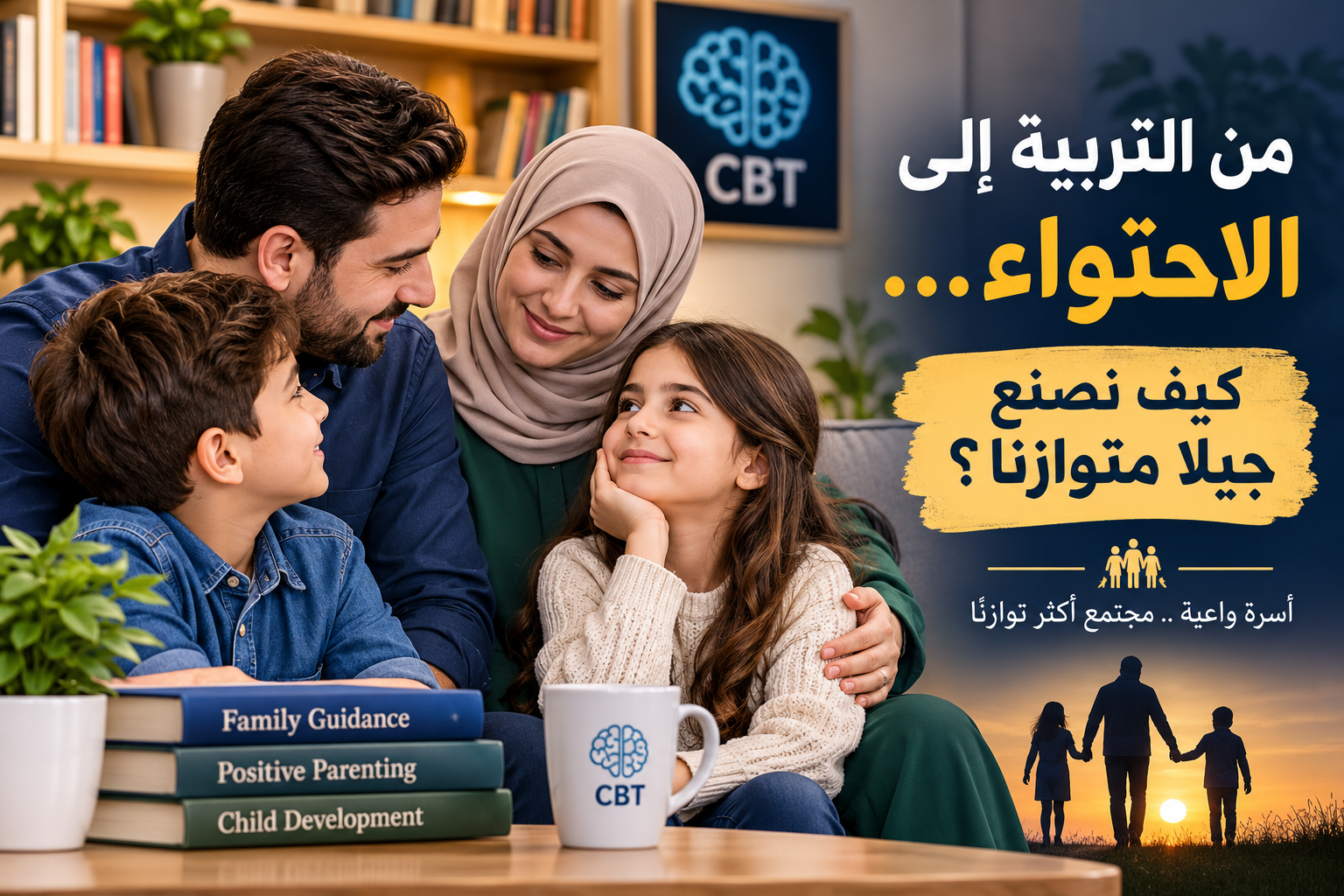
From Parenting to Emotional Support: How Can We Raise a Balanced Generation? Dr. Mustafa Alghrawi | Cognitive Behavioral Therapy (CBT) Specialist
Parenting is not about making our children obey us at all times, nor is our responsibility to turn them into copies of ourselves in the way they think or behave. Rather, it is about helping them discover who they are, understand their emotions, and develop personalities capable of facing life with confidence and balance.
In many homes, we ask our children to remain calm while failing to provide someone who genuinely listens to their feelings. We encourage them to express what is inside, only to respond with anger or ridicule. We expect them to develop self-confidence while constantly comparing them to others. This is where a silent gap begins to emerge between parents and children. It may not always appear through obvious conflicts, but it can manifest in withdrawal, stubbornness, low self-esteem, or a search for attention and acceptance outside the family.
Children do not need someone merely to feed them, educate them, and provide for their material needs. They also need someone who makes them feel valued, whose opinions matter, and whose emotions are never treated as a burden.
Conscious parenting begins with understanding the child, not attempting to control them.
A child's stubbornness may sometimes hide a fear they cannot express. Behind anger, there may be a feeling of neglect, and behind silence, there may be an experience for which the child has not yet found the right words. Therefore, addressing behavior without understanding its underlying causes may lead us to treat the symptoms while allowing the real problem to grow internally.
This is where family and educational counseling becomes essential. It is not simply an intervention when problems become serious; it is a culture built on prevention, understanding, and guidance. It helps parents develop the skills needed to interact effectively with their children while providing children with a safe environment for psychological and social development.\
It is importan
r\n\r\nt to understand that emotional support does not mean overindulgence, that love does not mean the absence of boundaries, and that discipline does not mean harshness. A father can be firm without being frightening. A mother can guide without hurting. A family can establish clear rules without making a child feel rejected whenever they make a mistake.
Our children learn more from the way we respond to their mistakes than from the advice we give them. A child who is humiliated whenever they make a mistake may learn to hide their errors. In contrast, a child who receives guidance and support in understanding and correcting mistakes learns responsibility, confidence, and accountability.
We must also recognize the role of schools. A school is not merely a place for acquiring knowledge; it is an environment where children's personalities, relationships, and social skills develop. Therefore, cooperation between families, schools, and educational counselors is essential, particularly in identifying early behavioral and emotional changes and addressing them without labeling, stigmatization, or arbitrary punishment.
A balanced generation is not created by families free of problems or schools without challenges. Rather, it is shaped by environments that know how to deal with difficulties when they arise, transform mistakes into opportunities for learning, turn differences into opportunities for dialogue, and make guidance a means of building character rather than breaking it.
We may not remember all the advice we heard during childhood, but we certainly remember how our parents made us feel when we made mistakes, how they responded to our sadness, and whether we found safety and reassurance in their presence when we needed them most.
The greatest gift we can give our children is not a path free of difficulties, but the confidence, awareness, and emotional support that enable them to navigate life without losing themselves.
Let us move from a style of parenting based on commands and fear toward one built on understanding, dialogue, and responsibility. We are not raising children for childhood alone; we are shaping individuals who will carry their thoughts, emotions, and values into society for many years to come.
A child who finds security within the family learns how to provide security to others. And a person raised with respect becomes better equipped to build balanced and healthy human relationships.