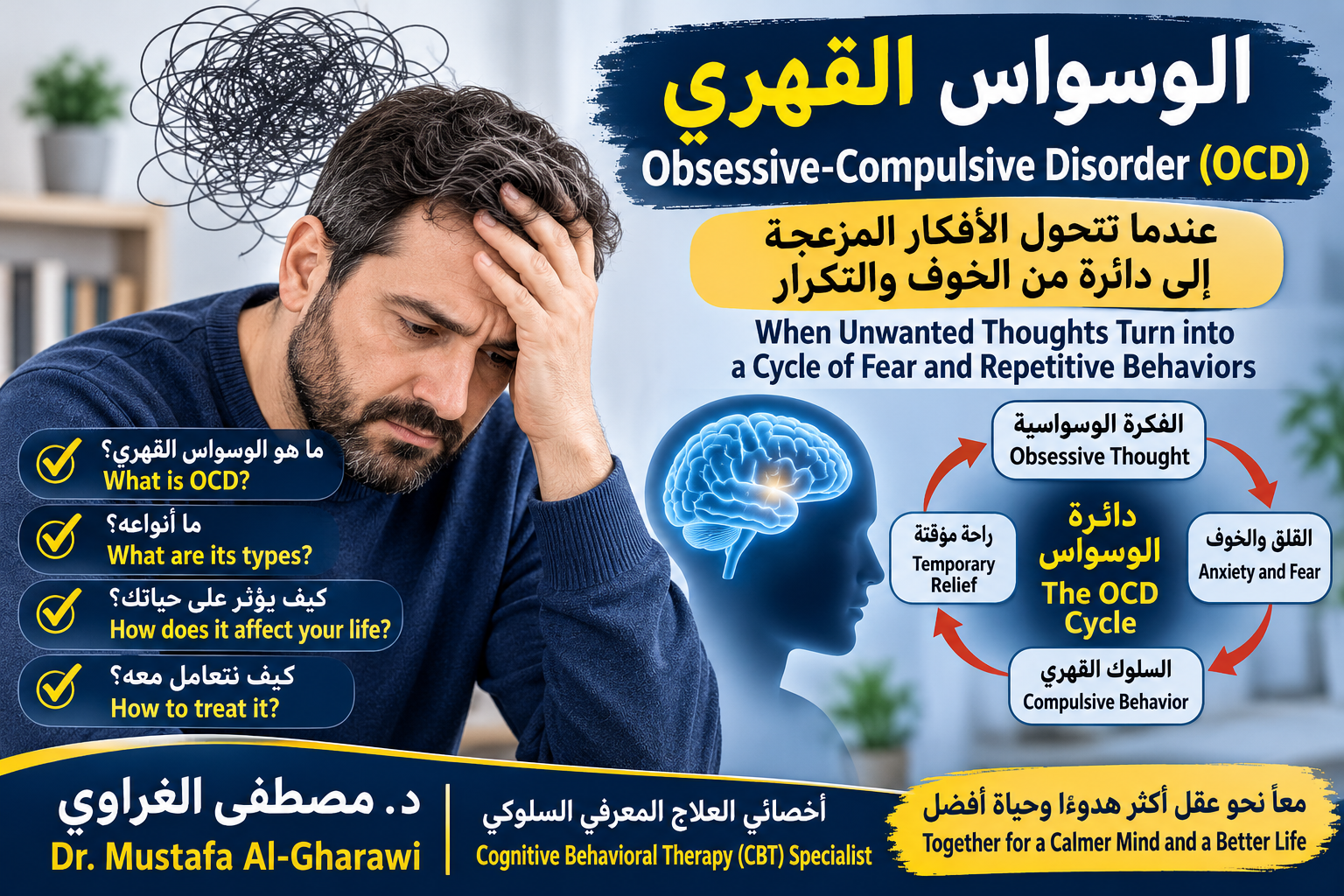
Obsessive-Compulsive Disorder (OCD): When Unwanted Thoughts Turn into a Cycle of Fear and Repetitive Behaviors Dr. Mustafa Al-Gharawi | Cognitive Behavioral Therapy (CBT) Specialist
What Is Obsessive-Compulsive Disorder?
Obsessive-Compulsive Disorder (OCD) is a mental health condition that affects the way a person thinks, feels, and behaves. People with OCD may experience persistent, unwanted, and intrusive thoughts that cause anxiety, fear, and emotional distress. To reduce this distress, they may feel compelled to perform repetitive behaviors or mental rituals.
These behaviors may provide temporary relief, but they often reinforce the cycle of obsessive thoughts and compulsive actions.
OCD does not mean that a person is weak, lacks awareness, or cannot think rationally. It is a condition that requires understanding, proper assessment, and appropriate psychological support.
How Does the OCD Cycle Begin?The problem often begins with an unwanted thought that suddenly
enters a person's mind. This thought may involve cleanliness, illness, harming others, making mistakes, or doubting everyday actions.
As the thought repeats, the person begins to experience anxiety and fear. They may try to eliminate the thought or reduce their anxiety by performing a specific behavior.
For example, someone may wash their hands repeatedly even though they have already washed them. Another person may repeatedly check whether the door is locked or whether electrical appliances are switched off. Some people repeat prayers or religious rituals because they fear they have made a mistake.
These behaviors provide temporary relief, but the obsessive thoughts eventually return.
This creates the OCD cycle:
Obsessive thought → Anxiety and fear → Compulsive behavior → Temporary relief → Return of the obsessive thought.
What Are the Main Types of OCD?
OCD can appear in different forms, and its symptoms vary from person to person.
1. Contamination and Cleaning Obsessions
People may experience an excessive fear of germs, dirt, or illness. They may repeatedly wash their hands, shower, or clean objects even when there is no reasonable need to do so.
2. Checking and Doubting Obsessions
People may struggle to trust their memory or decisions. They repeatedly check doors, appliances, or everyday tasks, even when they know they have already completed them.
3. Religious or Scrupulosity Obsessions
Some people experience unwanted intrusive thoughts related to religion or religious practices. They may feel excessive guilt or fear and repeatedly perform ablution, prayers, or other rituals in an attempt to achieve certainty and reassurance.
4. Intrusive Thoughts and Unwanted Mental Images
People may experience disturbing thoughts or mental images that they do not want. These may involve harming others, losing control, or other sensitive subjects.
It is important to understand that having an intrusive thought does not necessarily mean that a person wants to act on it or that it reflects their personality or values.
5. Symmetry, Ordering, and Perfectionism Obsessions
Some people feel a strong need to arrange objects in a particular way or achieve a specific sense of order and perfection. They may experience significant anxiety when things do not match their expectations.
What Is the Relationship Between OCD and Thinking?
From a Cognitive Behavioral Therapy (CBT) perspective, the problem is not necessarily the appearance of the thought itself, but rather how the person interprets and responds to it.
Unwanted thoughts can occur in many people's minds. However, someone experiencing OCD may interpret these thoughts as dangerous or meaningful and begin asking:
Why did I think this way?
What if something bad happens?
Does having this thought mean I am a bad person?
What if I do not check and something goes wrong?
These questions increase anxiety and create a strong need to find answers, reassurance, or complete certainty.
The therapeutic goal is to help individuals change their relationship with their thoughts rather than constantly fighting to eliminate or prevent them.
How Does OCD Affect Daily Life?
OCD does not affect thinking alone. It can interfere with many aspects of everyday life.
A person may spend hours washing, cleaning, checking, or repeating certain actions. This can lead to delays at work, difficulties at school, and problems completing daily responsibilities.
Family and social relationships may also be affected because of repeated requests for reassurance or pressure on family members to participate in compulsive behaviors.
Some individuals may experience emotional exhaustion, reduced self-confidence, distress, social isolation, and depression or anxiety alongside OCD.
How Can Cognitive Behavioral Therapy (CBT) Help Treat OCD?
Cognitive Behavioral Therapy is one of the important and effective psychological approaches used to treat OCD.
One of its most recognized techniques is Exposure and Response Prevention (ERP).
This approach helps individuals gradually and systematically face situations and thoughts that trigger anxiety while learning to resist performing the compulsive behaviors they previously used to reduce their distress.
Important therapeutic strategies include:
1. Identifying Obsessive Thoughts
Individuals learn to distinguish between intrusive thoughts and facts. They understand that having a thought does not make it true or mean that they must act on it.
2. Understanding the Relationship Between Thoughts, Emotions, and Behaviors
Individuals learn how obsessive thoughts trigger anxiety, how anxiety leads to compulsive behaviors, and how temporary relief reinforces the cycle.
3. Reducing Checking and Repetitive Behaviors
Individuals gradually learn to reduce their responses to obsessive urges instead of giving in to every demand created by anxiety.
4. Gradual Exposure and Response Prevention
A structured treatment plan is developed, beginning with situations that cause lower levels of anxiety and gradually progressing to more challenging situations, while preventing compulsive responses with the guidance of a qualified specialist.
5. Accepting Uncertainty
One of the most important skills in managing OCD is learning to tolerate a normal degree of uncertainty and understanding that life cannot provide complete guarantees about everything.
6. Building Confidence in the Ability to Cope
Individuals learn that anxiety is a feeling they can tolerate and that they do not have to perform compulsive rituals to feel safe.
Practical Advice for People Experiencing OCD
- Avoid engaging in lengthy arguments with every obsessive thought.
- Do not make complete certainty your goal in every aspect of life.
- Recognize repetitive behaviors that provide only temporary relief.
- Avoid repeatedly seeking reassurance from others.
- Do not blame yourself for unwanted intrusive thoughts.
- Do not expect OCD symptoms to disappear within a day or two. Recovery requires practice and consistency.
- Seek help from a qualified mental health professional to develop an appropriate treatment plan.
Can People Recover from OCD?
Yes. Many people can achieve significant improvement in OCD symptoms and regain their ability to live more comfortably through appropriate treatment and commitment to a therapeutic plan.
In some cases, a combination of psychological therapy and medication may be necessary, particularly when symptoms are severe or significantly interfere with daily life.
Medication should never be stopped without consulting the prescribing physician.
A Final Message
Remember that a thought is not a fact, and feeling afraid does not necessarily mean that danger exists.
You do not have to follow every demand of OCD just to feel comfortable.
Do not allow your life to revolve around checking, repeating, and searching for absolute reassurance.
Change begins when you learn to understand your thoughts, recognize the nature of OCD, and gradually confront it using scientifically supported therapeutic approaches.
You are not your thoughts, and you are not a prisoner of your fears. You can learn to regain control of your life.
Dr. Mustafa Al-Gharawi | Cognitive Behavioral Therapy (CBT) Specialist